Rollers vs. W‑Profile Linear Bearings: Why We Switched (And Why It Matters for Your Rooftop Tent)
Introduction
Most rooftop tents on the market – including some of the most recognisable brands – rely on roller‑based guides for their lift mechanism. One well‑known brand has even patented its roller design. It sounds sophisticated. It looks good in marketing materials. And it works – on paper, in a clean lab, on a brand‑new tent.
But your tent doesn’t live in a lab. It lives on a vehicle roof. It lives through Australian outback dust, sudden downpours, 40°C heat, corrugated roads, and thousands of kilometres of vibration.
So we tested rollers. Then we switched to W‑profile linear bearings.
Here’s why.
The Problem with Rollers in Real‑World Conditions
In a controlled environment, roller systems perform adequately. The problem is that rooftop tents are not used in controlled environments.
Point Contact = Localised Stress
Rollers rely on point contact – a very small area transferring load between moving parts. This creates high local stress, which leads to:
- Accelerated wear patterns – visible after only moderate use
- Indentations on bearing surfaces – causing rough, uneven motion
- Reduced lifespan – the system degrades faster than it should
Dirt and Dust Are Trapped
In dusty environments (like Australia, the American Southwest, or African overland routes), rollers have a fundamental flaw: the contact path is exposed.
- Dust and grit get trapped between the roller and the guide surface
- Instead of clearing debris, rollers grind it in
- This creates a scratching, grinding feel when opening or closing the tent
- Over time, the system becomes noisy and stiff
Misalignment Kills Smooth Motion
Roller systems are sensitive to alignment. In the real world:
- Vehicle flex during driving can shift mounting points
- Repeated opening and closing introduces small misalignments
- Even minor misalignment causes uneven roller contact → rough operation
The Noise Problem
After repeated use – especially in dusty or sandy environments – roller systems get noisy. That grinding, clicking, or squeaking sound doesn’t just feel cheap. It signals wear. And it erodes the premium experience your customers expect.
What We Use Instead: W‑Profile Linear Bearings
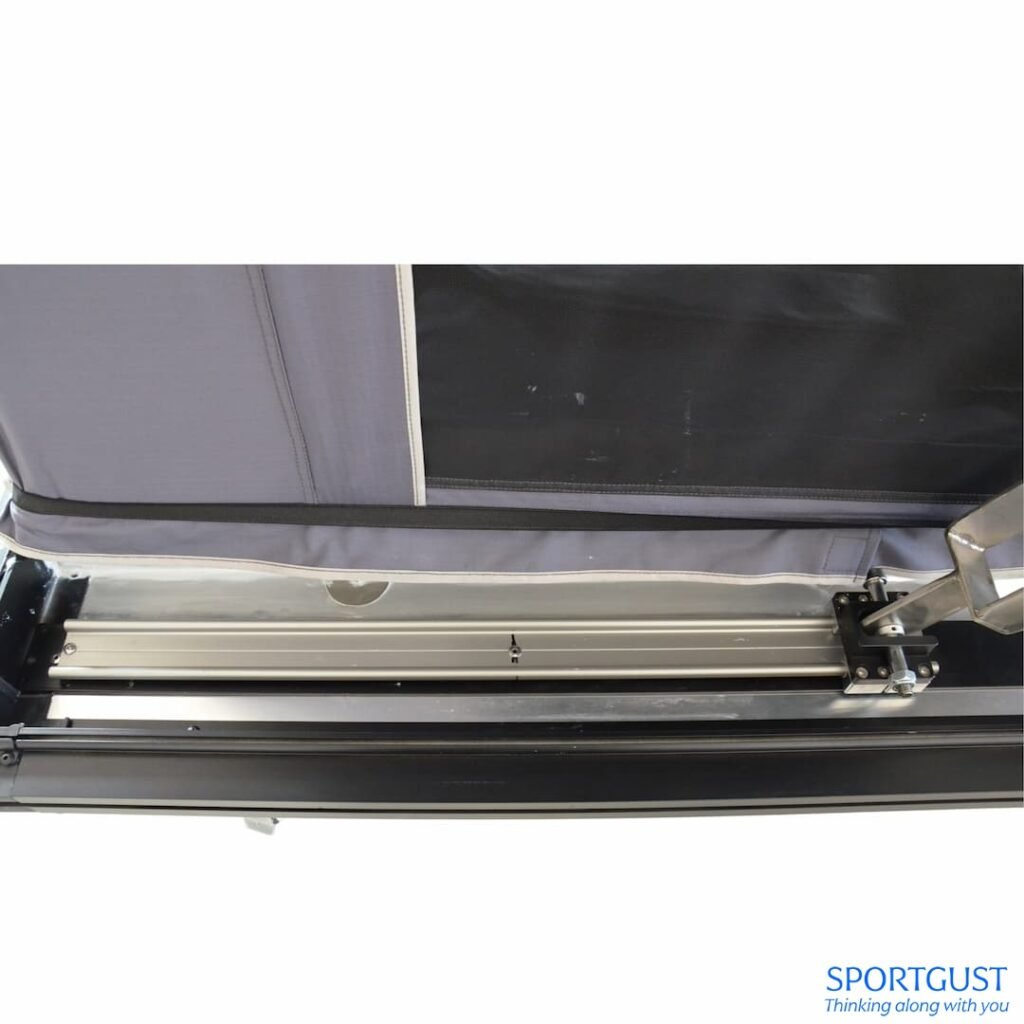
Instead of rollers, we use W‑profile linear bearings (also known as double‑row V‑groove bearings). The “W” shape creates two symmetrical 90° V‑grooves that run along the guide rail.
How It Works
| Feature | How It Improves Performance |
|---|---|
| Surface contact (not point contact) | Load distributes across a larger area → lower local stress → longer life |
| Self‑cleaning geometry | The angled V‑grooves push dust and debris out of the contact path, not into it |
| Consistent under side loads | The bearing captures the rail from two angles → stable even with misalignment or vehicle flex |
| Smoother after hundreds of cycles | W‑profile bearings actually wear in – they don’t wear out quickly |
| Quiet operation | No grinding, no clicking, no squeaking – even in dusty environments |
Why This Matters for Your Customers
A tent that’s hard to open or noisy to operate doesn’t feel premium. And if a customer is paying $7,000+ for an electric rooftop tent, “premium” is the whole point.
- Rental fleet operator → A tent that becomes stiff or noisy after 50 cycles means customer complaints and costly repairs.
- Campground owner → Guests expect smooth, effortless setup. A grinding mechanism breaks the illusion of quality.
- End‑user → They may not know why their tent feels rough. But they will remember that it doesn’t feel “right.”
Lab Conditions vs. Real Conditions
| Environment | Roller Performance | W‑Profile Bearing Performance |
|---|---|---|
| Clean lab (ideal) | Acceptable | Excellent |
| Dusty / sandy | Degrades quickly – dirt trapped in contact path | Self‑cleaning – remains smooth |
| Frequent use | Wear patterns appear early | Consistent over hundreds of cycles |
| Side load / misalignment | Prone to binding and rough motion | Tolerant – bearing captures rail from multiple angles |
| Noise over time | Becomes noticeable | Remains quiet |
Rollers work. In a lab. On a spec sheet.
But tents don’t live in labs. They live on car roofs.
What Competitors Do (And Why We Chose a Different Path)
We respect the brands that have popularised rooftop tents. Some of them use roller designs – one has even patented their system. That patent is clever. It’s marketable.
But clever marketing and reliable engineering don’t always go hand in hand.
We tested the roller approach. Extensively. In the conditions that actually matter:
- Australian outback dust
- Humid coastal environments
- Repeated open/close cycles (hundreds of them)
- Simulated vehicle flex and vibration
The conclusion was clear: Rollers degrade faster than they should. W‑profile bearings deliver consistently better real‑world performance.
We don’t use W‑profile bearings because they are cheaper. We use them because they are better engineering.
The Parts You Can’t See Matter Most
At SPORTGUST, we don’t cut corners on parts you can’t see.
- The adhesive that bonds the shell (ISR7003 – high‑speed rail grade) is invisible – but it delivers a 5‑year waterproof warranty.
- The gas struts (60,000 cycles tested) are hidden – but they determine whether the tent opens smoothly every time.
- The linear bearings (W‑profile, not rollers) are inside the mechanism – but they decide how the tent feels on day 500.
Good engineering is invisible. You only notice it when it’s not there.
Conclusion
Rollers work – on paper. But your customers don’t sleep on paper. They sleep in the dust, the heat, and the rain.
That’s why SPORTGUST uses W‑profile linear bearings. Not because it’s the easy choice. Because it’s the right choice.
👉 Contact SPORTGUST for B2B partnerships & custom engineering
This article is an independent engineering analysis based on SPORTGUST’s internal testing and industry experience.